Friday, May 26, 2017

IDLE MUSINGS - ITALIAN STYLE

My latest sojourn in Italy brought some interesting observations on the state of the country’s national car industry.

Italy is a country of extremes, nowhere more noticeable than the automotive landscape. At the bottom end of the market is the FIAT range of (almost) forgettable cars.

Take the FIAT Tipo, the company’s latest assault on the C-segment. It’s a car that is pedestrian in both design and engineering.

The Tipo is based on the ageing 2005 General Motors-FIAT small car platform, which underpins a plethora of very uninspiring cars.

Apart from taxis, the Tipo is a somewhat rare sight, compared to the Cinquecento range. 
There is no doubt in my mind that the only thing making money for FIAT is the 500, in all its forms.

The car itself has become Italy’s latest, and most successful, automotive icon, but that’s also true of the extended range including the 500+ wagon, which is based on the Jeep Renegade platform.

FIAT 500s literally infest every street in Italy, and why not? 

It’s a very well designed and engineered car; and the Plus and LWB versions are providing efficient, roomy family motoring for Italians just like their predecessors.
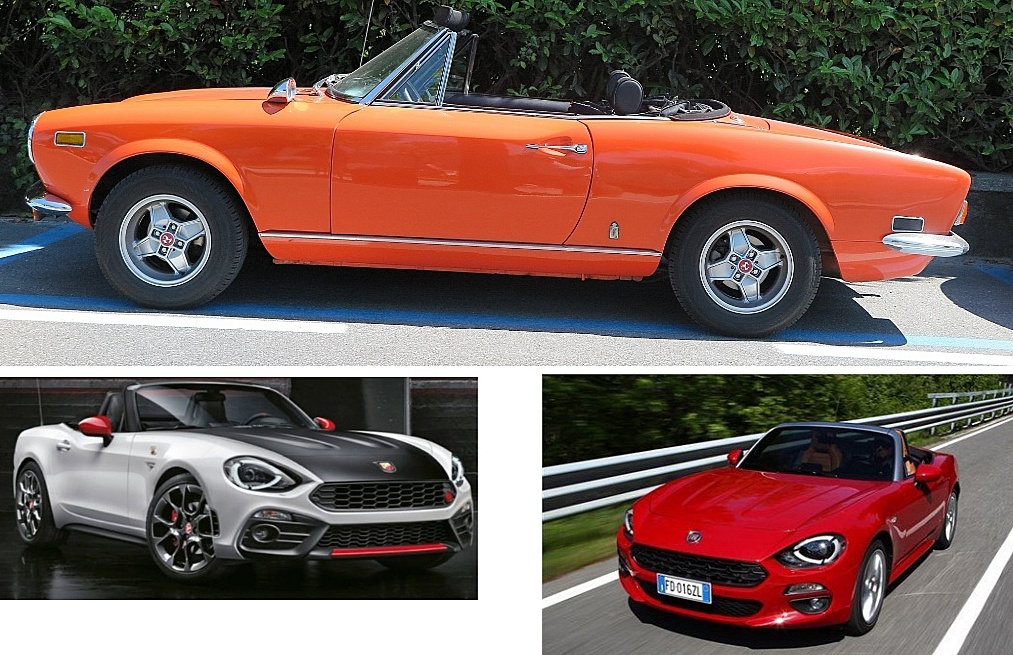
That other recent addition to FIAT’s lineup, the 124 Spider, is less in evidence in its home market.

I saw only two privately-owned 124s; but there were quite a few Abarth 124s rolling out of the AVIS rental car garage at Milano’s Malpensa airport.

Now, to our rental car for this year’s vacation.

The quirky Lancia Ypsilon hatch is built on a platform shared with the FIAT Panda, and the Ford Ka.

Of the three, Lancia’s design is the most individual; but the Panda is more practical, and the Ka certainly the best looking of the trio.

More on the Ypsilon later; but nothing provided greater graphic comparisons of the Italian automotive panorama than this photo at traffic lights in Como.


A Lamborghini, a FIAT 500 and a Vespa – that just about sums up the country’s choice of ‘wheels’ – from the lowliest to the grandest.


Of course, as a paid-up member of the Alfisti I was keen to see how many Alfa Romeo Giulias I would see.
It was a grand total of – one!

On the car ferry between Bellagio and Menaggio there was a base model, diesel Giulia with a family on board. I asked the owner why I had seen so few, and his answer was simply that they were too expensive in Italy, and Italians had lost faith in the brand!

One thing which truly endorsed the success of the hatchback concept was this shot from the streets of Como.

The B-segment hatch is the car of choice for most people in Europe, and the variety ensures there's plenty of competition in this sector.

FAREWELL OLD FRIEND

As I fired up one of the last Australian-built Holden Commodores, I was greeted by the bellow of the same 6-litre V8 that powers the Corvette and the Camaro, Stateside. 

However, despite its motorsport-bred muscle, the Commodore is a car with excellent family values.

You can safely sideline this car for your wife, family and loved ones in general.

This final Commodore is an outstanding achievement for GM-Holden.

The quality is a world’s best benchmark, the fit and finish as good as any from the premium manufacturers and the safety and reliability is legendary. I’m sad to see it go.

In fact, in my opinion this is the best all-round sedan car from any part of the GM world; it’s certainly streets ahead of any car built by GM in America.

Quite a few Americans got see this fact close-up and personal, as GM-Holden exported thousands of Aussie-built cars to the USA between 2004 and 2017.

It goes something like this; between 2004-2005 Holden sent 31,500 two-door Monaro coupes badged as the Pontiac GTO; then between 2007-2009 41,000 Commodore sedans crossed the Pacific badged as the Pontiac G8; and in the most recent, but ill-fated export program, Holden shipped 12, 953 Commodores badged as the Chevrolet SS, and in addition 7,300 Statesman configured as Police Patrol Vehicles (PPV).

There were two big things holding back Holden’s potential in the USA. One of the most obvious is the currency relativities as the US dollar has always been traditionally stronger than the Australian dollar. Many times however, during the period after the sign-off of the Export programs, the AUD strengthened, making the import cost higher.

However, the muscle threatened by the powerful United Auto Workers union is really what put paid to Holden’s potential success - before a single Aussie-built car landed in the Port of Los Angeles. The union told GM, it would agree to small numbers for GM’s Pontiac division, providing the cars were premium-priced. But, there was no way the UAW would tolerate big numbers, threatening jobs in the USA.

This final Australian-built Commodore is a delight to drive. Apart from the roar of the big V8, there’s the excellent ride and handling, developed from dozens of years of expertise bred at Holden’s huge proving ground at Lang Lang – east of Melbourne.

It is simply one of the best-sorted, most refined performance sedans I’ve ever driven.


From the Commodore news scoop I developed back in 1976 when I was editor of MODERN MOTOR magazine (Check out - MEET THE PRESS - PART FOUR), to today’s nostalgic drive of the VF Commodore, I reflected warmly on the development of one of the best cars ever to emerge from a GM factory.

Thursday, May 25, 2017

CX5 - AN SUV MARKET SUPREMO

Within days of writing about the launch of Mazda’s latest CX-5 SUV in Australia, comes the opportunity to experience the car in the metal, and the latest version reveals impressive refinements in the cabin, as well as minor tweaks of the exterior styling.

Most of the hoo-haa about the facelift concerns new electronic driver aids, which you may or may not appreciate.

However, what will impress is the revised interior trim, the quality of the finishes, and the fit and finish margins. It’s hard to rationalize the extent to which Mazda has upgraded the interior at this price level.


I’m enough of a realist to recognize that a Mercedes-Benz SUV buyer would simply not consider choosing a lowly Mazda; however once inside the new CX-5, you could be forgiven for seeing it as a Benz-beater.

Mazda is on record saying that it is not chasing volume (despite the success of its market-leading Mazda 3), and that it is content with steady incremental volume growth allowing it to maintain profit margins.


That’s a sound business outlook, given the very competitive state of the overall market for compact hatchbacks and SUVs, which indicates that Mazda’s mojo is working for it.

Sunday, May 21, 2017

MAZDA MAGIC

It’s hard to reconcile the Mazda car company that Ford Motor acquired a 35% share of in 1996, when Mazda was sort of bumping along the bottom, to the confident, globally successful company it is today.

Ford sold down its holding by 20% in 2008, which meant it surrendered its effective control of the company. Ford retains 13.4%, which means it gets dividends from what is now one of Japan’s most profitable car companies.


In Australia Mazda vies for number one, but seems content to be a consistent Number Two or Three in the sales race. The magic word at Mazda Australia is ‘margin’; it does not appear to want to chase mass volume.

Its April sales show it’s keeping pace with the 2016 results Year-to-Date; but a wider dissection of the 2017 sales data shows that in effect each of its models has plateaued, until the launch of the much-revamped CX5 SUV this month. That event proved the old car industry adage that to stay among the leaders, companies need a constant flow of new, attractive products.

Consumers are fickle, and with car affordability at record levels, they will pick and choose, confident that whatever they buy today, it will be safe, reliable, and competent.

For me, the main attraction of the Mazda products is the investment in design, engineering and innovation, whilst to some degree eschewing a lot of the very intrusive technology which most companies lavish on their cars; and ‘soak the customers’ with option pricing.

Remember this is the company that persevered with developing the Wankel rotary engine, very successfully.

Using this powerplant Mazda competed in the 24 Hours of Le Mans, with distinction - although the noise of the Mazdas changing gear just as they passed the pits was truly abominable.
I think Mazda scores with many buyers because of the outstanding dynamics of its cars and SUVs.


It has evolved its segment offerings with the current Kodo design aesthetic, and its SkyActiv technologies, resulting in lighter, stronger cars, delivering greater fuel efficiency and real driving pleasure.

Yes, I hear you say, other car companies are doing the same thing, so what makes Mazda different? I think Mazda has discovered a mojo that is delivering consistently on many fronts – engineering, design, driving dynamics and quality.


Thinking back over the range of Mazdas I have driven in the past year and a half and I would be happy to have any one of them in my garage – that is if I actually ‘liked’ SUVs – but the issue is the same – they are outstandingly good cars and Mazda well and truly deserves its strong position in the global car maket.