Thursday, August 11, 2022

COULD ASTON MARTIN LOSE ITS CHAIRMAN? by John Crawford

Aston Martin’s Chairman Lawrence Stroll is THE pivotal figure in both the saving of the car company, and its recent entry into Formula One. Stroll, his own cash, plus a string of backers, have basically pulled the car company back from the brink, and launched an ambitious PR strategy, using a Formula One team, to keep the focus on the 109-year old company.


However, there is a highly volatile legal battle brewing which will take Stroll into the courtroom to try to save his own skin. The details have been revealed in the magazine BUSINESS F1 by its publisher Tom Rubython. The following story comes directly from the July 2022 edition:


A Fight to The Finish:

In June 2021 Aston Martin revealed to the stock market for the first time that its Swiss dealer (St Gallen) was entitled to a four percent royalty on every mid-engined car it would sell for the next ten years.


It was yet another material fact that had been excluded from Aston Martin’s IPO prospectus and its annual accounts, and it prompted Stroll to cancel the deal leading to a flurry of legal action. But before the end of this year there will be a showdown at an arbitration tribunal in London and whomever loses faces oblivion.


Nebula Project AG provided Aston Martin with a USD$100 million guarantee to cover the development costs of the Aston Martin Valkyrie, with the backing of one of its biggest customers, renowned Swiss car collector, Albert Orbist.


Aston Martin Lagonda Global Holdings plc (AML) unilaterally terminated the venture in June 2021 simultaneously cancelling all agreements with Nebula Project AG, and other companies led by the Nebula principals, Dr. Andreas Baenziger and Dr. Florian Kamelger, including the largest Aston Martin dealer in the world, St Gallen.


Dr Andreas Baenziger, Dr Florian Kamelger and Lawrence Stroll on the attack

 
Aston Martin Lagonda has since embarked on a series of ‘scorched earth’ legal actions against Baenziger and Kamelger and Nebula Project AG plus associated companies alleging bankruptcy and fraud. The claims were thrown out, and Swiss legal observers say the ploy is a well-known legal ruse to try and disable a company by bankruptcy, separate to parallel proceedings.


Nebula Project AG conceived the car which became Project Valkyrie and in 2016 took the plans to then AML Chairman, Dr. Andy Palmer. However, Palmer was unable to finance the project and that’s when the Swiss doctors stepped in with the guarantee. Nebula Project AG underwrote the entire project in return for the four percent royalty on every Valkyrie, Valhalla and Vanquish mid-engined model.


The deal would have been worth USD$350 million to Nebula, but its legal claim for damages and compensation for the deal being cancelled is USD$190 million.


BUSINESS F1 points out that Lawrence Stroll was completely unaware of the deal with Nebula as there was no mention of it in the IPO, nor the three sets of annual accounts which followed.


The deal could have meant AML owing Nebula USD$200-$300 million over the next ten years – which would have come straight off AML’s bottom line.


AML’s statement regarding the termination said: ‘AML is no longer liable for any of these royalty payments’.


This is probably the most serious issue which AML has faced in its struggle to remain viable, and fund not only all the elements of running the car company, but also leading the funding of the F1 team.


It is also a truly personal issue for Lawrence Stroll, who could face dismissal by the AML Board if his strategy fails in the arbitration proceedings. Watch this space!


JOHN CRAWFORD


*My thanks to Tom Rubycon and BUSINESS F1 for the opportunity to publish this story.

Tuesday, August 9, 2022

AUSTRALIA LAGS IN FUEL EFFICIENCY STANDARDS by John Crawford

The Australian Institute has released a report outlining that $5.9 billion in fuel costs could have been saved if fuel efficiency standards were adopted in 2015.

“Australians are being left behind simply because, as a nation, we are still accepting gas-guzzling cars with no emissions standards. This is costing commuters money at the petrol pump and holding Australia back from reducing our emissions,” said Richie Merzian, the climate and energy program director at the Australian Institute.

“Fuel efficiency standards are a widespread and modest policy mechanism used by policymakers globally to ensure new cars are more efficient and less polluting. These standards exist across 80 per cent of the vehicle market but not in Australia despite numerous reports, inquiries and government commitments saying we need them.

“The new government has a golden opportunity to implement robust fuel efficiency standards in line with Europe. The policy is popular, helps Australians with cost-of-living, and will help drive the uptake of cleaner vehicles.”

Clearly the caps have a signicant influence on clean air quality in cities. This simulated graphic gives an indication of Bangkok's AQI (92%) and London's AQI (25%). Clearly Thailand, like many nations has a long way to go.

Fuel efficiency standards measure the efficiency of a vehicle and how it consumes fuel. The calculation made to determine the fuel efficiency of a vehicle is applied to vehicles sold within a country, adding to a total fleet cap.

Effectively, it’s a cap placed on how many vehicles can be sold by a car maker without fuel-efficient vehicles (like hybrids and EVs) being added to the equation. Selling these fuel-efficient vehicles typically alleviates the fleet cap, balancing sales out. If too many non-fuel efficient vehicles are sold, the car maker may be penalised.

Additionally, effective fuel efficiency standards need to be in line with other countries, otherwise a country like Australia that, hypothetically, introduced weak standards, will still only get less efficient vehicles than European markets. If we’re getting standards, they need to be strong.


In 2018, the average carbon dioxide intensity for new passenger vehicles in Australia was 169.8gCO2/km compared to 129.9gCO2/km in the United States, 120.4gCO2/km in Europe and 114.6gCO2/km in Japan.


Then, of course there's the issue of diesel emissions. The EU is introducing tough new standards, and phasing out diesel subsidies - a tough decision given the popularity of diesel in Europe, and the USA.


Companies, like Volkswagen, have shown that it’s possible to bring tailpipe emissions down to around 90gCO2/km.


This would extend the life of ICE cars, making the transition to zero-emission vehicles far easier, more affordable, and best of all totally practical.


JOHN CRAWFORD


Saturday, August 6, 2022

FERRARI 250 GTO -THE HOLY GRAIL? by John Crawford

Mel Nichols, now there’s a name which resonates strongly in the UK with car enthusiasts.

He was once the editor of Britain’s famous CAR magazine, and later Editorial Director of Haymarket Media where he led the team that resuscitated AUTOCAR, the world’s oldest car magazine (launched in 1895).


His Australian mate Steve Cropley (right) joined him there and it wasn’t long until AUTOCAR won its century-long weekly battle with MOTOR, which sadly disappeared.


But the Mel Nichols I know hails from Tasmania, and we first met when he landed in Sydney to work at the K.G. Murray Publishing Company, then the publishers of WHEELS and SPORTS CAR WORLD.


In mid-1971 I was a disc jockey on Sydney’s number one Top 40 station, and filling in my spare daytime hours writing the occasional freelance automotive story for anyone who would commission me.


I mostly wrote articles which were technical in nature, specifically intended to simplify highly complex explanations of new cars, suspension systems, engines and the like. I also used to drive road test cars for photo shoots, but Mel and I got together when I got my first commission for a full road test story.


Ford Falcon GTHO Phase III

The car was the Ford Falcon GTHO Phase 3, and as I got to writing the report I struggled with expressing the ‘essence’ of the car.

I spoke to Mel about the challenge, to which he replied: “What’s your first impression?”


I said: “It feels like having your face gently stroked, then getting slapped in the face to wake you up.” Mel replied: “Okay, that’s where you start.” 


The story flowed from that instant, and I am forever grateful to Mel for unlocking the potential writer in me. We have been good friends ever since.


I'm proud to report that Mel has gone on, from his 22 years at Haymarket Publishing, to yet another career, this time as a professor at a number of British universities, teaching the next generation of aspiring journalists.


During Mel’s time as editor of CAR he had the opportunity to enjoy one of his most famous drives when he was able to give a Ferrari 250 GTO its head, courtesy of its owner, who himself was not short on fame.


It was 1979, and the feature was so impressive that Mel’s wife, Wendy (who was Art Director for CAR, before going on to design THE WORLD OF INTERIORS) produced one of CAR magazine’s most iconic covers.


It is probably true to refer to the 250 GTO as the ‘Holy Grail’ of Ferraris. At least, in consultation with my good friend Peter Robinson, we decided that just on the subject of value and auction results it had to be Ferrari’s most important model.


Going back to 1979, Mel has produced a short summary of his large feature for CAR magazine, which in Word form ran to 13 pages and over 5000 words. It’s a pity I can’t reproduce the feature here. It is too trite to describe it as journalism, it was and remains an outstanding piece of writing. So, here’s the short version, with a twist:


“As beautiful to hear as it was to see, as fast through the corners as it was down the straights and, above all, the greatest friend a driver could wish to have…” That’s a perfect summary of the 250 GTO, written recently by Andrew Frankel on The Intercooler.


 “I knew exactly what Andrew meant: it was its forgiving nature that amazed me most when I spent six days with Nick Mason’s GTO. The PINK FLOYD drummer (below) has become one of Britain’s most passionate car collectors and the story of his ownership of the 250 GTO is as fascinating as the car itself.


“My never-to-be-forgotten experience started at Goodwood. Nick was at a Ferrari day there with his then recently acquired GTO and I asked if I might drive it for a story for CAR. I’d hoped for perhaps a few laps. But he said: “Leave me your car, and take the GTO home.” Incredible!


“I lived in a terrace house in Clapham, south London, but drove it immediately from Goodwood to friends in Norfolk. The 170-mile drive there, alone through the night, was one of the most intensely thrilling and rewarding that I've experienced.


(PHOTO: Richard Davies)


“I spent the next day driving it, and as fast as I could. The steering and chassis conveyed such messages that you could feel the action of the tyres upon the road. Then there was the mettle and sound of that glorious 3.0-litre V12, and the most sensuous of gearshifts, connecting you directly with the car's mechanical heart.


“It handled with a trace of stabilising understeer then a marvellous neutrality before nudging, under full power, into lovely, flat and progressive oversteer. You could sense its balance and finesse well enough to feel confident about setting it into a drift through long, lasting bends.


“It was potent yet somehow gentle too, and never treated my efforts with contempt. After that, I returned to London and used the GTO as my daily driver before taking it back to Nick. It was perfectly happy in traffic. CAR was all about ‘new’ cars, but I put the then 16-year-old GTO on the cover with the words ‘Six days on the road with Enzo’s greatest hit.’


“It’s still hard to believe it happened and I will be forever grateful to Nick for his generosity.


“However, I have an admission to make (which I explained nervously to Nick, when returning the car). As I said, back then I lived in a terrace house in Clapham, so my only option during my six days, was to park it in the street overnight!


"Was I worried? 
Certainly – but at the time the GTO was just an old racing car, and few people knew of its value so I took some reassurance from that. However, thankfully the GTO survived its inner-city exposure to all the fateful possibilities which may have damaged it, and it survived to be driven and enjoyed. So much so, that experience is one of the most rewarding of my career.”


MEL NICHOLS


PS: Just a note on values, to guide your thinking about how 'special' the 250 GTO is in the rarified air of historic Ferraris. Nick Mason paid £37,000 for chassis 3575 in 1978. The most recent recorded sale was at The Quail in 2014, where chassis 3851 sold for £22,843,633.00. That's right, over £22 million! I guess 'Holy Grail' is a fitting description.


Thursday, August 4, 2022

MOKE SURVIVES, AFTER 58 YEARS! by John Crawford

There’s a saying in the Australian vernacular to describe something that’s so tough, it survives regardless of the punishment it endures. The saying is: “You couldn’t kill it with a stick!”


I couldn’t think of a more appropriate description of how the humble Mini Moke, designed by the father of the Austin Mini, Sir Alec Issigonis in 1964, has survived 58 years of changes, to its design, and manufacturing locations.


I have a special interest in this basic, utilitarian vehicle (originally described as a 'buckboard'), going back to 1977 when I accompanied adventurer Hans Tholstrup, to compete in the Singapore Airlines London-to-Sydney Car Rally in a specially-modified Moke Californian. The Moke was our home for a month!


The world’s longest rally, 30,000km through 30 countries in 30 days, threw up some unique challenges, but we finished at the Sydney Opera House in 35th place!


Moke has been through a plethora of refinements and powertrain changes, but has always retained its original form factor which ensured its popularity, mostly in global resorts.


Today, you can still buy a Moke (above), now made by a new company called MOKE International, and it can be delivered with a petrol powertrain (if permitted by local regulations), but it’s most appealing version is fully-electric – and I believe this will help Moke continue to endure for longer than anyone could have believed.


To focus on MOKE International’s fresh approach to selling the vehicle, its website offers an order form to allow you to design your ‘bespoke’ MOKE. The company even has a new take on its dealership model, launching ‘Casa Moke’ in St. Tropez, France.


Taking advantage of Moke’s beach resort image, the ‘dealership’ is about as laid back as you can get.


The history of the humble Mini Moke is a chequered career of concepts, inspired by the basic specifications, but refined and modified over the years to accommodate differing needs.


Australia played the most important role in Moke’s history. Moke manufacturing began in 1968 at Leyland Australia’s Zetland plant in Sydney, before moving to a smaller plant in Enfield. In total 26,000 Mokes were made in Australia between 1966 and 1981. Leyland Australia also enjoyed a very healthy global export market.

Moke production at Leyland Australia's Enfield factory in Sydney


This number far exceeds the number made by the parent company, BMC, of 14,518 between 1964 and 1968; and 10,000 made in Portugal from 1980-1983.


Following closure of the Portuguese factory, Moke was bought and sold by a range of companies, until the ‘brand’ ended up in the hands of MOKE International which threatens to extend the life of the vehicle well out into the future with its status as a recreational EV.


The specs may be modest, but this is a little 'buckboard' with a BIG heart.


JOHN CRAWFORD

Wednesday, August 3, 2022

BEWARE! THE DEADLY POTENTIAL OF TOUCHSCREENS by John Crawford

Back in May 2020 I posted an opinion on DRIVING&LIFE that touchscreens are a dangerous development, and now there’s vindication from UK connectivity specialist VNC AUTOMOTIVE, which suggests that driver distraction and inattention are far bigger contributors in nearly half of all fatal and serious injury road accidents than many in the car industry realise.


VNC says many new cars are so laden with technology that driver distraction is growing at an alarming rate.


The company said that the dominance of touchscreens in interior design is one of the major contributors to the rise in accidents caused by inattention.


Try telling that to the hip young designers, who appear to have convinced car companies that doing away with switches, buttons and sliders is a ‘good thing’.


Some serious research by the NHTSA in the USA reveals that drivers are very comfortable reaching for a switch/button/slider to make adjustments, without taking their eyes off the road.


They are used to the scope of movement, and their ‘feel’ for just how much adjustment they need is a cognitive function which represents the perfect harmony of your brain linked to your fingers. The researchers concluded this is much easier for humans to cope with.


As opposed to being forced to look away from the road view, to work out just where on the touchscreen they need to place a finger, and then further distraction occurs when the driver needs to check the level of function change required.


This is not being alarmist. ‘Anything’ which distracts the driver from the road ahead is potentially deadly. Asking a driver to multi-task by operating a touchscreen whilst driving is going to come back and bite the carmakers.


I believe that once this view about potential danger caused by touchscreens gains currency, the industry could well be asked to reverse direction on the elimination of manual switches/buttons/sliders.


JOHN CRAWFORD

Tuesday, August 2, 2022

ALONSO TO JOIN ASTON MARTIN F1 by John Crawford


As the news broke that four times World Champion Sebastien Vettel was retiring from F1 at the end of this year there was naturally a great deal of speculation about who would replace him.

That question has now been answered with this media statement from Aston Martin F1 yesterday that Fernando Alonso will join the team in 2023. Vettel has been replaced by another F1 world champion.
This year, competing for Alpine, Alonso has shown he hasn't lost his touch.


Alonso has won two Formula One World Championships, the FIA World Endurance Championship, the 24 Hours of Le Mans twice, the 24 Hours of Daytona once and the Euro Open by Nissan.


Silverstone, UK – Monday August 1st

Aston Martin Aramco Cognizant Formula One™ Team is delighted to confirm that Fernando Alonso will join the team in 2023 on a multi-year contract. The whole company is very excited to bring Fernando’s incredible experience and brilliant pace and racecraft to the team. The recruitment of a special talent such as Fernando is a clear statement of intent from an organisation that has committed to developing a winning Formula One team.

Fernando Alonso:


"The passion and desire to perform that I have witnessed convince me to maintain my enjoyment and commitment to the sport. I intend to win again in this sport and therefore I have to take the opportunities that feel right to me.”


JOHN CRAWFORD

Monday, August 1, 2022

NEW DRIVER AT THE DRIVE WEBSITE by John Crawford

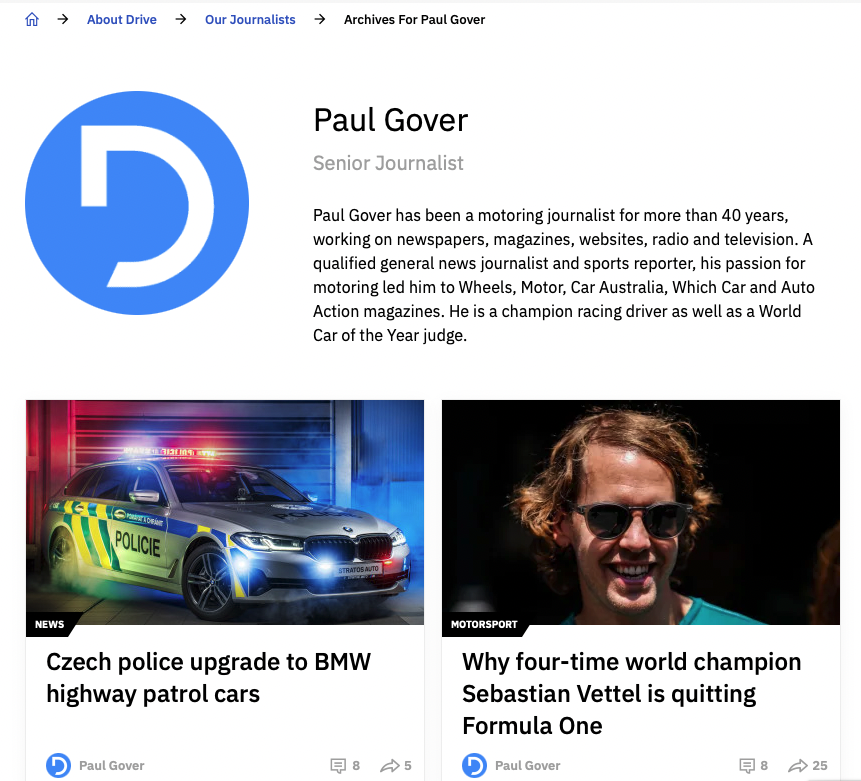
My good friend and regular contributor to DRIVING & LIFE, Paul Gover, has landed a gig with <www.drive.com.au> and now appears regularly in the website's content.

You can check out his contributions on everything from new cars, Formula One and driver safety aids.


Paul is one of the world's most experienced automotive writers and has driven road cars, rally and racing cars all over the world, and I'm sure the readers of DRIVE will benefit from his experience and his intimate knowledge of 'the automobile'.

JOHN CRAWFORD