Saturday, October 1, 2022

MY LUXE LIFE by John Crawford

As I approach the inevitable probability of seeing the horizon of my life, I have to be grateful for all the great cities, great hotels, great drive locations and fabulous cars I have enjoyed over my 40 years involved with cars. Life in the car industry has surely treated me well, and I never take a moment for granted.


Over the next few weeks I am going to give my memory of great times a jog with a short re-visit to some of those great moments.


Some of these memories occurred when I was an automotive journalist, and later editor of MODERN MOTOR magazine here in Australia.


My first visit to Monaco for the Grand Prix and my happy introduction to Italy in 1976, which started a lifelong love affair with the country, plus driving through Germany in a Porsche 924.


In 1977 my biggest ever adventure was competing in the Singapore Airlines London-to-Sydney Car Rally, but following my return to Australia there were great experiences with both Jaguars and Range Rovers, when I was appointed PR Manager for Leyland Australia.


Then there were more overseas trips, including the Series III Jaguars in southern England, and surfing the hills and valleys of Eastnor Castle estate in Range Rovers.


The year 1986 was a big one for both Rover and Jaguar, with the highly anticipated launch of the Rover XX, debuting as the Rover 825. Then Jaguar's most important car to date - the XJ-40. All of these events in England were hosted at some of Britain's finest country house hotels.


After I joined Bentley in 1998, the events took on a greater emphasis on being held in spectacular locations, plus interesting side events and high class hotels.


Then threaded through these events was my love of motor sport and especially being at Bathurst in 1985 to see the Jaguar XJ-S driven by John Goss and Armin Hahne take the chequered flag.


And, most special, being at Le Mans in 1988 to see Jaguar, and later, in 2003 Bentley, each claim victory in the world’s most gruelling endurance race.


This Post really mentions just a few, because there were many more memorable moments I hope to have space to chronicle. One of the most pleasurable aspects of these moments were the great automotive journalists I was able to invite along, many of whom have become good friends over many decades.


My epithet should read: “He was not a rich man, but he led a rich life.”


JOHN CRAWFORD


Tuesday, September 27, 2022

MORE ON EV CHARGING - THE ESSENCE OF THE PROBLEM by John Crawford

Here’s yet another couple of cautionary tales of (almost) early-adopters of EVs.


FACEBOOK POST:
“Hi EV community. RANGE PROBLEM. We recently purchased a used 2021 MG ZS MG Essence. We are on our first holiday with the car; Melbourne to Albury to Merimbula (and return).

“We have been shocked (devastated really) at the short range the car has on the highway. When the battery is full the range indicates around 250km (or about 210km with aircon).


“However, when we drive at 110kmh we only get around 110km range. We did anticipate a reduced range on the highway of course, but not 50%. It means we drive for about an hour, then have to spend an hour charging - that is IF we can find a 
rapid charger (sometimes we have had to stay and charge somewhere overnight if no rapid charger is around).

“We are travelling as a couple, with a moderately filled car, and with 2 surfboards on roof racks, so we don't feel we are overly burdening the car with weight or drag, and we are not using a roof trunk.


“We are driving in ECO mode. So, is this the disappointing experience others have had with highway driving with EVs or is this an MG ZS issue, or are we doing something wrong?”


And now, we move to an ABC-TV story about the difficulty charging an EV in an apartment block.

Melbourne EV user Mauricio Perez laughs about his bizarre predicament. 

Maurizio Perez (Photo:ABC-NEWS John Gunn)

This 100m yellow extension cable is the only way he can feasibly charge his electric car at home. He plugs into his living room's power point, drops it down off his third level apartment's balcony, and then into the building's car park up to his Tesla.

"I think given the safety issues that are involved, that's probably not acceptable," Mauricio says.

The situation in apartment blocks is not simple. The vast majority of apartments in Australia are managed by bodies corporate. These entities represent all the people who own the apartments in a building.

Shared spaces like car parks and gardens are common property. You need body corporate approval to renovate them. And works need to go to a vote.

The power that supplies shared spaces is also generally managed by body corporate too. 

Mauricio is using public charging stations in his area instead. These can sometimes have queues for a spot, and he has to wait around while his EV charges. He fills the time by doing errands like grocery shopping.

This is working for him at the moment, but he'd like the option of charging his Tesla while it's parked at home, and he's sleeping, or working. 

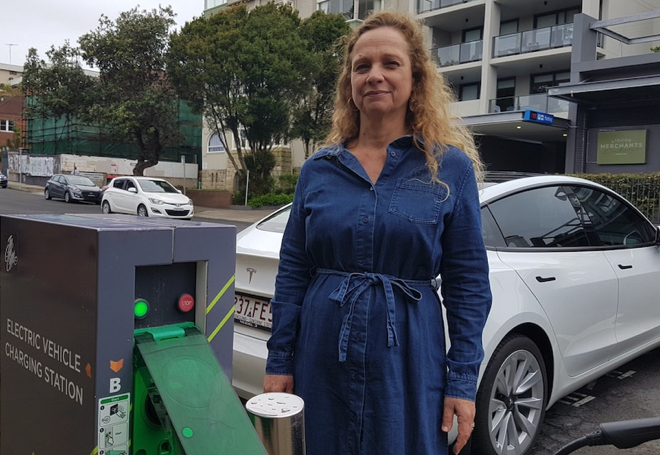
"This is about convenience," he says. Actually, says Macquarie University  professor of law, Cathy Sherry (below), it's an issue around 'social equity'. Most older Australians and generation X Baby Boomers own their own free-standing home.

"For younger people, very often the only form of affordable housing they can access either as tenants or owners will be apartments.”

“In Australia, 2.2 million people live in apartments or high rises. They are typically on lower incomes, and many of them are renters.”

(Photo:ABC-NEWS Thorsten Joses)

Ross Shepherd of Charger Installer MyEnergi says the reason why apartment jobs are often far more expensive is all the copper wiring involved. Plus, even some new buildings need extra work on mains.

Then, older apartment blocks usually need additional work running into more thousands to hook up the charge point to an individual apartment’s meter.

Some of the more complicated apartment jobs that MyEnergi has quoted have started at $20,000. This compares to as low as $1,500 for free-standing homes.

The fact is, given all the infrastructure which either needs changing, or re-inventing, 2035 is not all that far away. I suspect this will NOT be the ‘new dawn’ of changes in motive power that EV proponents promise.

JOHN CRAWFORD

PS: I have said many times, I am not agin EVs. I just want the broader community to understand that EVs are NOT a 'silver bullet' to lower automotive emissions. Like hybrids, they are a step along the way, and why governments, carmakers and environmentalists keep backing the world into a corner can only reference one issue - 'they haven't got a clue how to solve the problem of widespread auto emissions, so they're jumping on the first bandwagon that comes along.'


Monday, September 26, 2022

DRIVEN PERSONALITIES - VALÉ PAUL DEAN by John Crawford

Pardon the pun, but this man was a real Dean of automotive journalism. Paul Dean was the longtime automotive writer for the Los Angeles Times, and when they pensioned him off he began a new career as the automotive editor for The Robb Report – at the time America’s leading lifestyle magazine. 

Sadly he has died, aged 88, ending a stellar life and career.

We were very, very good friends. But, it could’ve started out badly.


Paul, thanks to his solid British stock, was an opinionated,  garrulous, grumpy, god-awful automotive editor for most people who tried to ‘sell’ him a story for the LA Times.


He hated mediocre PR people with a passion, to whit, his message on his answer phone at the Times went this way: “If you’re a PR person trying to sell me a story, put it in the mail, and don’t bother me. If I need to, I’ll get back to you.”


When I joined Jaguar Cars North America in early 1991 as VP of Public Relations, I was warned by my switched-on PR consultant in LA, the wonderful Joe Molina, about Paul’s attitude - which could leave PR people quaking in their boots.


I tried a different tack. I wrote him a letter on the very impressive Jaguar letterhead saying that I wanted our first meeting to be useful and productive, and that I would send a Jaguar to pick him up from the Times, to join the President of Jaguar Cars NA, Mike Dale, and I for a private lunch in the Boardroom of our biggest LA dealer.


After a very amicable lunch, and an hour of interview and discussion, we had the car return him to the Times. From that meeting onwards Paul and I created a strong bond of personal friendship and mutual admiration for each other which has lasted over 30 years.


In 1998 when I returned to America as the nascent PR Director for The Americas for Bentley Motors, Paul picked me up at LAX after I flew in from Sydney on a Sunday morning, and took me to a fabulous Bentley Car Club display in Long Beach, where he introduced me to the movers and shakers of the historic Bentley clubs on the West Coast.


Always a stickler for a ‘genuine’ story about a brand or a car, I always made sure that whatever I pitched to him had integrity and value. He always returned the favour, and in December 2003 called me to say that The Robb Report’s weeklong judging of the latest Premium Luxury cars had just ended, with the judging panel awarding Robb Report’s Car of The Year to the Bentley Continental GT coupe. In the interests of transparency, Paul abstained from voting.


His writing was crisp, tight and never failed to focus on the real ‘essence’ of the car, whether it was good or bad – and some of his scathing reviews resulted in a lot of turnover of PR people at various car companies. Paul Dean was one of the great American automotive writers across more than 40 years, and his ‘good opinions’ were widely sought and certainly had an impact on sales on the West Coast.
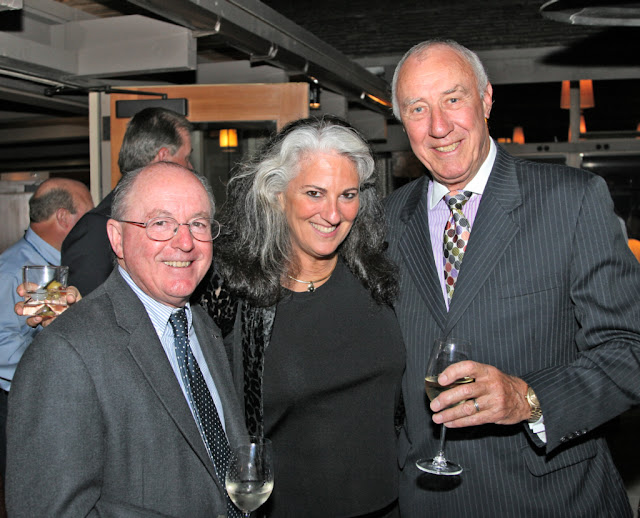

Yours truly with Penny and Paul Dean, Monterey 2006

Paul Dean was a man of many parts. During his life he clocked up many achievements, starting out as a news reporter, then a foreign war correspondent, columnist, magazine publisher, accomplished tennis player, pilot and race car driver. In 1992, during his time at the LA Times, Paul won a Pulitzer Prize for his investigative report on the LA Riots.


Paul left big shoes to fill when he left the LA Times, but they were filled well and truly by a young up and coming writer, who also displayed a huge talent for making words create great ‘pictures of the mind’ and was always entertaining. He was a great writer, who went on to become the first automotive writer, ever, to win a Pulitzer Prize for automotive journalism.


His name is Dan Neil, and he is now the automotive critic and editor for the Wall Street Journal. I’m glad I built strong friendships with two of the best journalists I’ve ever dealt with.

They had very different personalities, but I can guarantee always wrote truthful, useful, entertaining and memorable reviews.


R.I.P. Paul.


JOHN CRAWFORD

Friday, September 16, 2022

EVs DIFFICULT PATH TO POWER by John Crawford


Since Russia cut off supplies of gas to the EU the price of electricity in Europe is rising at an alarming rate and this has placed a huge obstacle in the path that EVs are following to become the dominant model of personal mobility.


EV proponents in Germany are saying that the EU governments must act quickly to ensure the cost of running an EV (that is, charging) must not rise faster than petrol, otherwise EVs will become less-attractive. Compounding the issue is the gradual reduction, and in fact elimination, of some subsidies to buy an EV.


The push to electrify driving got off to a slow start (thanks to the high prices of EVs), but no-one saw this coming.


As EVs rolled out of factories across the world Russia had not yet attacked Ukraine.


Gas supplies via the Nordstream pipeline were secure, but a combination of Russia eliminating the gas supply and the coming colder winter has meant that not only have electricity prices sky-rocketed, but charging stations are putting up their prices too.


Allego, one of Germany’s largest charging station operators, raised its prices at the start of this month from 43 cents a kilowatt hour to 47 cents. Express charging, via a continuous current, has risen from 65 to 70 cents a kilowatt hour while the fastest, so-called ultra-fast charging, has gone up from 68 cents to 75 cents a kilowatt hour.


Discount supermarkets, DIY chains and furniture stores which had until recently offered customers free charging while they shopped are now introducing charges.

One suggestion that could be relatively swiftly implemented would be to increase the vehicle tax on diesel and petrol cars.

This may be an attractive alternative to pro-EV governments, but it is actually blind to the real advantages of continuing with ICE cars. Here's a graph produced one year ago, which due to recent developments is totally invalid.


“Electric cars are losing their charm,” Helena Wisbert, director of the Duisburg-based Center for Automotive Research, wrote in a recent commentary for the economic daily Handelsblatt.

If, hypothetically, charging infrastructure is a headwind for EV sales, what are the major headwinds for installing new, fast charging units?

Two obvious reasons exist. For one, this is a classic “chicken and egg” situation: property managers don’t want to install chargers if there are no electric vehicles to use them, and drivers don’t want to buy electric vehicles if there are no chargers to fuel them. Secondly, fast charging technology is still in early days, thus it remains expensive.

Okay, these are clearly unintended consequences, and unforeseen developments, but it clearly underscores that this emotional push for EVs to dominate the automotive landscape defies a basic truth and that is that the world needs to pause and understand that ICE cars still have a future, and the impressive potential for carmakers to further reduce tailpipe emissions mean that the more affordable ICE cars can (and in my opinion) should continue to be an option.


Also, there is a rapidly-growing realisation that Toyota may be the only carmaker whose hybrid technology is exactly the right compromise between ICE and EVs.

As recent research in the USA concluded: “Focusing on battery-powered electric vehicles may neglect more fruitful means of emissions reduction. “The future is eclectic, not electric.”


JOHN CRAWFORD

Thursday, September 15, 2022

BENVENUTI a DUE NUOVI ITALIANI by John Crawford

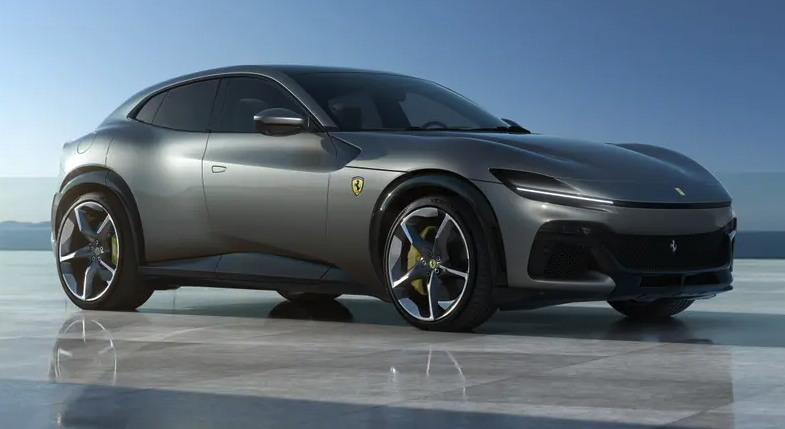
The headline says: “Welcome two new Italians” and these stars from Stellantis are at opposite ends of a spectrum that dominates the global car market – suv’s and crossovers. Except that neither is an SUV.


Alfa Romeo’s Tonale is a premium, small crossover in the same segment as the Audi Q3, BMW X1 and the Mercedes-Benz GLA, whilst the Ferrari Purosangue is a Ferrari, which means it’s sports car.


There may be genuine ultra-luxe SUVs out there, but the Purosangue’s pricetag pushes it so far upmarket it’s out on a limb by itself.


In the junior league the Tonale offers a turbocharged 1.5L ICE with hybrid backup, weighs in at 1525kg, and gets from 0-100km/h in 8.8 seconds.


In the serious league the Purosangue weighs in at 2033kg and the 6.3L V12 launches it to 100km/h in 3.3 seconds.

Both vehicles are aimed at the people who demand their favourite brand produces  something more in keeping with market faves at the moment, but don’t expect to see either one covered in mud, and wading through the equivalent of Land Rover’s jungle track.


Both brands have held their European press events, and both cars get rave reviews for their performance and handling – what would you expect?


In their own way they’re each a thoroughbred, and the finish, materials and outright performance and handling need no apologies.


The Tonale is headed for an ultra-competitive segment, but I think the Purosangue will dominate the upper end of the GT market. Ferrari’s new CEO Benedetto Vigna went to great lengths to emphasise that whilst the Maranello marque was about to offer something akin to a Lamborghini Urus, Bentley Bentayga or Maserati Levant, that’s not how the purists who created the car see it.


It has the Ferrari bloodline, and the styling makes no pretence about its intentions. The Tonale is also a very stylish competitor, with very subtle surfacing.


I welcome both cars, and I think just on looks alone they will be successful. Trust the Italians to one up everyone else in the style stakes.


JOHN CRAWFORD

Wednesday, September 14, 2022

CADILLAC'S VOYAGÉ INTO THE FUTURE - by John Crawford

Cadillac has a special place in DRIVING & LIFE, simply because I truly admire the original Cadillacs which revealed outstanding quality in design and engineering. Remember, the brand beat Rolls-Royce in the famous Dewar Trophy competition in Britain, winning the cup in 1908.


My good friend Jim Hall has dug around the Cadillac archives to reveal a concept car from Cadillac which hinted at a design revolution resulting in Cadillac introducing a new design language which influenced brand design over the next 20 years.


Cadillac presented the Voyagé concept car at the 1988 Chicago Auto Show, and it was a show-stopper. Cadillac design up until then was treading water, and the marque had descended into such a boring stream of land yachts, it was heading for irrelevance.


However, under the guidance of the great Chuck Jordan (GM’s VP of Design), and Director of Advanced Design Jerry Palmer, the Voyagé concept was penned by a young man called Jerry Brochstein.


For almost the first time in decades Cadillac seemed set to break out of the mould of GM’s ‘B Body’ cars, which were examples of stiff, upright and square design themes.


Although the Voyagé was 5.4m long, it had an impressive drag-co-efficiency of 0.28. 


Aerodynamically it was a superb example of wind-tunnel efficiency.


The front wheel 'spats' remained closed when the car was driving in a straight line, to aid aero efficiency, but during turning they opened out to allow wheel movement.


The flowing lines of the Voyagé led straight to an outstanding Cadillac – the 1992 Seville.


The Seville was (whoa!) also front-wheel-drive, but its saving grace was the new Northstar DOHC V8 which imbued it with quiet, smooth and flowing power to equal the power delivery of its major competitors.


Voyagé design cues also led to the 2004/2006 Cadillac CTS-V and the STS-V.

These were cars that allowed Cadillac to update to compact sports saloons which looked good and offered outstanding and very competitive performance.

 
I know, because thanks to my friendship with Bob Lutz, I got to blast around Detroit’s outer environs in a slick, supercharged STS-V for a weekend.


But, it wasn’t just the flowing exterior which set the Voyagé apart. Inside the Cadillac design team had produced a range of features which would take decades to come to market, but clearly revealed that the Cadillac guys were ‘futurists’.


How about this for a list of forward-think features: A dual-screen navigation system; a hands-free phone which could be voice-activated; a rear-view video camera, and its best party trick – an ‘active’ four-wheel-drive system that could computer-activate the front axle in case of a loss of traction.


The Voyagé was followed in 1989 by a two-door coupe employing the same design language - the Cadillac Solitaire.  The car was fitted with parallelogram hinges for its huge doors so they didn’t have to swing so far when open.


Unlike the Voyagé (which had a Cadillac V8), the Solitaire packaged a Lotus-engineered 6.6L430HP 48v V-12.


In my mind this is the same sort of advanced tech which could be found in Cadillac’s early cars, leading to a proud marque badge which read – Cadillac-Standard of The World.


The new Lyriq SUV and Celestiq sedan EVs look set to hatch a new set of standards for the historic marque, as adventurous as the Voyagé was in its time.


JOHN CRAWFORD